

DopaSpeak › Brain-friendly language learning
GuideBrain-friendly language learning: 6 principles.
Brain-friendly learning means working with your memory instead of against it: understand first, then practice actively, recall often, get clear feedback and spread your practice over time.
Here are six principles. For some, the research is very clear; where one is more of a good rule of thumb, we say so. Each comes with how to use it when learning a language, with or without an app.
Free to play · no download · first lesson without sign-up · phone, tablet and PC

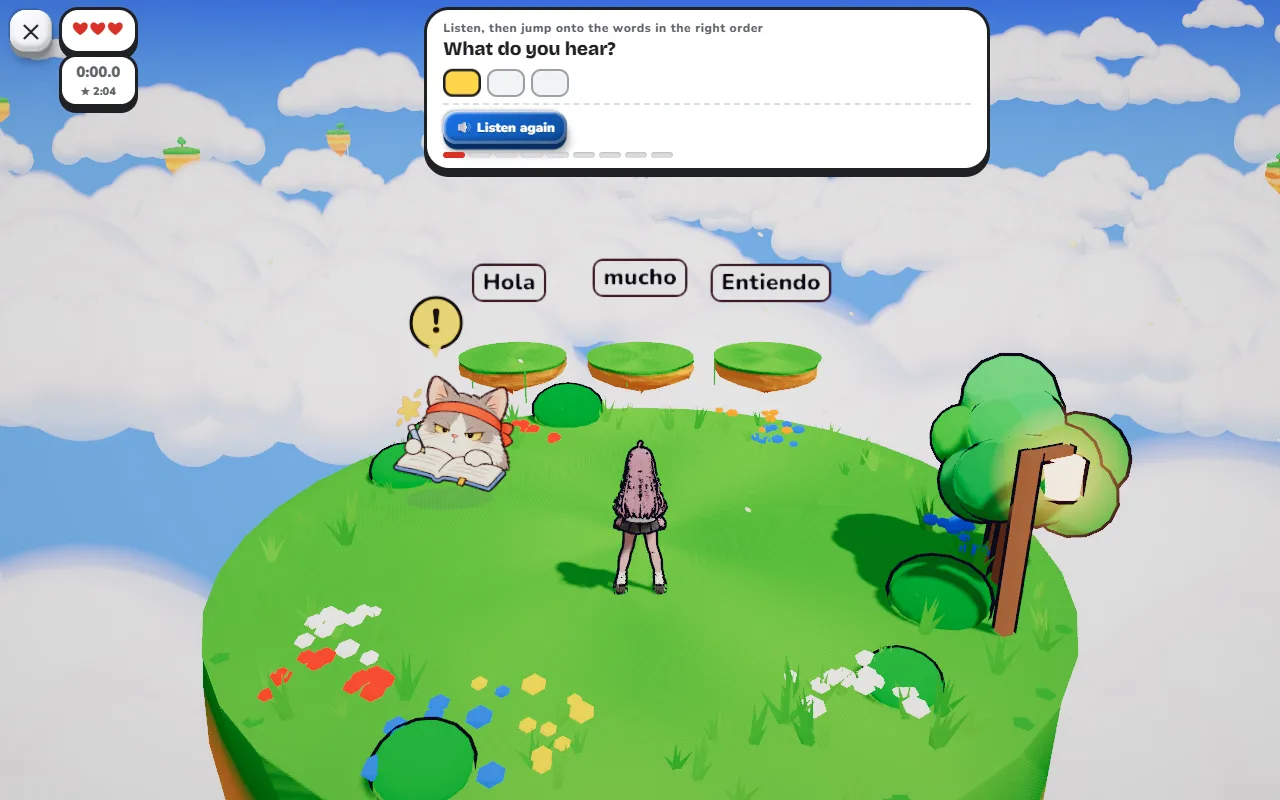
1. Understand before you memorize
What you understand, you can connect to what you already know, and that lasts longer than memorized sounds. For languages, that means looking at what each word literally means before you drill the sentence. “¿Trabajas mucho?” reads “Work much?”: Spanish needs no “do” and no “you”, the ending of “trabajas” already says who.
Learn vocabulary inside sentences, not as lists. That gives every word a context you can find it by later.
In DopaSpeak: in the lessons, you see the literal meaning of every foreign word, and every sentence comes from an everyday dialogue.
2. Recall actively instead of rereading
This is one of the best-supported findings in learning research: pulling something out of your memory strengthens it more than reading it again. It's called the testing effect or retrieval practice (Roediger and Karpicke 2006; Dunlosky et al. 2013).
In practice: cover the translation and say the sentence yourself before you check. Build sentences instead of just looking at them.
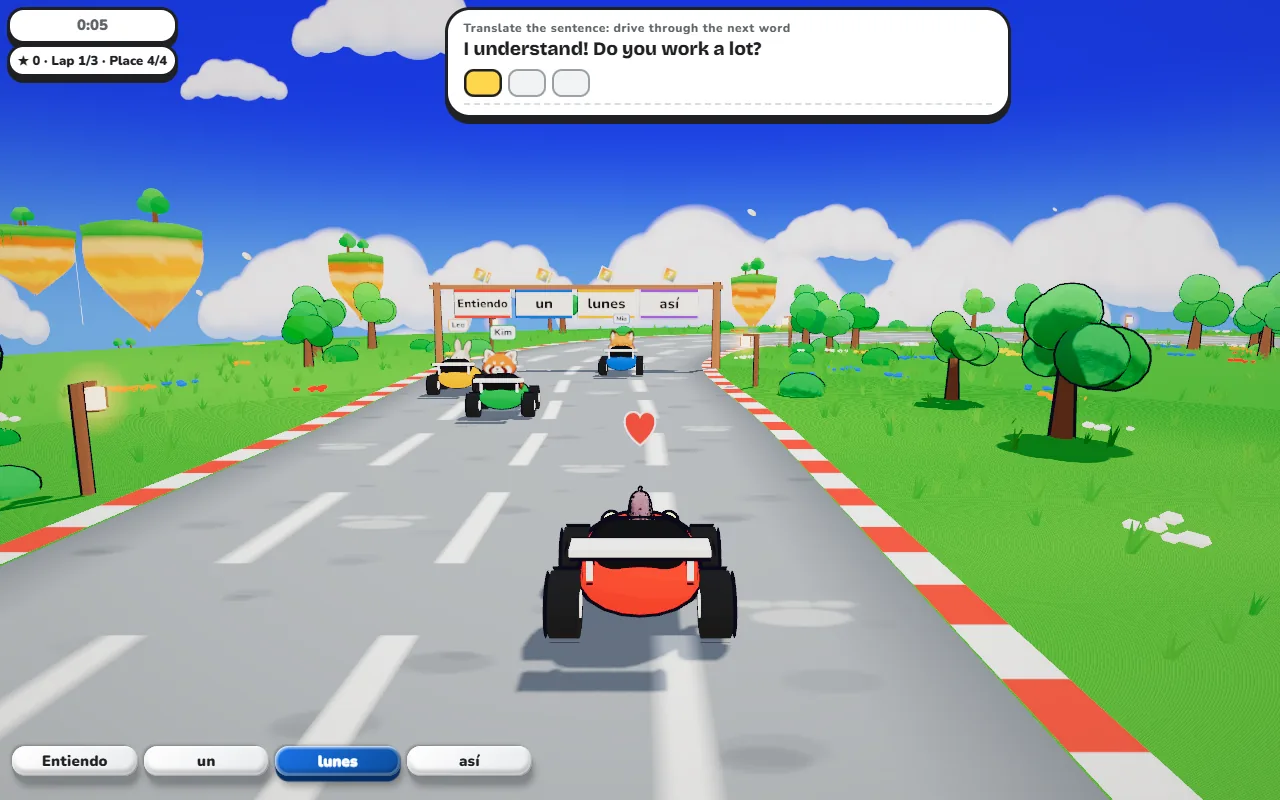
In DopaSpeak: every answer you pick and every sentence you build from words is a small act of recall.
3. Get clear feedback
Feedback helps most when it tells you exactly what was right and what to do differently next time, not just that you were wrong (Hattie and Timperley 2007).
In practice: test yourself in small steps, and when you get something wrong, look at the correct answer before you move on.
In DopaSpeak: in the 3D levels wrong islands crumble away, the Daily Puzzle marks every slot as right or wrong, and anything you missed in a lesson comes back at the end of it.
4. Spread your practice out
In studies, practice spread over several days works better than the same time in one go. The gap between repetitions is a learning factor in itself (Cepeda et al. 2006), especially for vocabulary.
In practice: short and daily beats long and weekly. Revisit sentences after a day, after a few days and after a week.
In DopaSpeak: a stop takes a few minutes, and the Daily Puzzle and daily missions give you a reason to come back tomorrow. The game doesn't schedule reviews of individual sentences for you today.
5. Link word, image and sound
When a word is also tied to an image or a scene, there are more ways to find it again. The idea goes back to dual coding theory (Paivio 1986). It's a useful rule of thumb, not a guarantee: images help most with concrete words.
In practice: read sentences out loud, listen to them, and picture the situation where you'd say them.
In DopaSpeak: every lesson is a stop on an island with a topic, from the café to the train station, and sentences are read aloud by AI voices.
6. Stick with it because it's fun
The best method is useless if you quit after a week. What interests you and feels like progress, you keep doing.
In practice: pick content and a format you look forward to, and set small, visible goals.
In DopaSpeak: a story, islands to unlock, three stars per 3D level and a best-time ghost you want to beat. If you like, keep a daily streak, and a streak freeze covers days you miss.
Example: a Spanish sentence in the game
Take “¿Trabajas mucho?” First you see it decoded: Trabajas (Work) mucho (much). In a lesson you hear it and tap its words in order. Later you race through sentences from the same lesson in Word Kart, and in the Daily Puzzle you put a sentence together yourself. Understand, recall, feedback, repetition.
Sources
- Roediger, H. L., & Karpicke, J. D. (2006). Test-enhanced learning. Psychological Science, 17(3).
- Dunlosky, J., et al. (2013). Improving students' learning with effective learning techniques. Psychological Science in the Public Interest, 14(1).
- Hattie, J., & Timperley, H. (2007). The power of feedback. Review of Educational Research, 77(1).
- Cepeda, N. J., et al. (2006). Distributed practice in verbal recall tasks. Psychological Bulletin, 132(3).
- Paivio, A. (1986). Mental representations: A dual coding approach. Oxford University Press.
FAQ
What does brain-friendly learning mean?
Shaping learning to fit how memory works: understand first, then recall actively, get clear feedback and spread practice over time.
Can you learn vocabulary in a brain-friendly way?
Yes, best in context: words in real sentences, with their literal meaning, recalled regularly instead of just reread, spread over several days.
Does a game replace a language course?
No. DopaSpeak is a game. It trains understanding, vocabulary and sentence building with everyday dialogues from A1 to B1. For speaking freely, you also need real practice with people.
How long should I study each day?
Short and regular beats long and rare. Ten to twenty minutes a day is a good start.
Is DopaSpeak free?
Yes, you can play DopaSpeak for free in your browser.

Try it with one sentence.
No download, first lesson without sign-up.